

Cholesterol has been villainised as the waxy substance that clogs arteries. The public message is simple: low-density lipoprotein (LDL) is “bad” cholesterol, and high-density lipoprotein (HDL) is “good” cholesterol. So, the lower the LDL levels, the better. Even total cholesterol levels should be kept low. Yet a new longitudinal study points to a cholesterol paradox, suggesting things are more nuanced. While high cholesterol still raises the risk of cardiovascular disease, unusually low cholesterol levels, including LDL, may signal a higher risk of premature or cancer mortality. More intriguingly, the range considered “optimal” may differ between populations, indicating that cholesterol targets should be more personalised rather than universally applied.
When Low Cholesterol Becomes the Question
Much of modern cholesterol management is built around one outcome: cardiovascular disease. That focus makes sense. Generally, excess LDL cholesterol is linked to atherosclerosis, and lowering LDL may reduce the risk of cardiovascular events, especially in high-risk individuals. However, this framework missed two important facts. First, cardiovascular disease is not the only way humans die. Second, cholesterol is not just an artery-clogging substance.
To be fair, cardiovascular diseases remain the largest single category of death, accounting for 32% of global deaths in 2023. However, that also means over two-thirds of deaths came from other causes. Cancers are the second leading cause of death, responsible for 18% of global deaths in 2023. In high-income countries, the proportions of cardiovascular and cancer deaths are more balanced, at 28% and 21%, respectively. Other causes of death include infectious diseases, chronic respiratory diseases, diabetes, kidney diseases and neurological diseases.
That distinction matters because cholesterol is not only a cardiovascular risk marker. It is a fundamental material of life, needed for cell membranes, steroid hormones, bile acids, vitamin D synthesis and immune function (Figure 1). In other words, cholesterol is essential for normal physiology. Yet current lipid guidelines mainly focus on cardiovascular pathology, while the potential risks of very low cholesterol remain insufficiently addressed.
So, the more interesting question is not whether very high LDL can damage arteries. The question is whether cholesterol can also become too low and, if so, whether that carries health risks of its own.
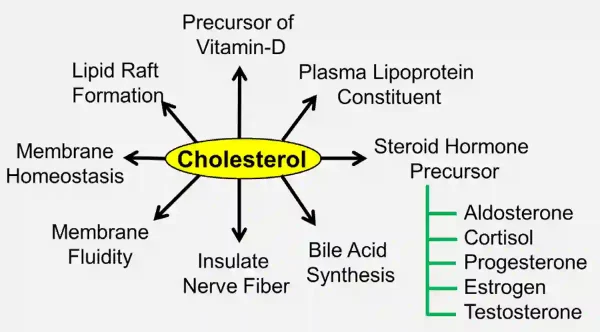
Figure 1. The essential roles of cholesterol in the body. It helps stabilise cell membranes, supports nerve insulation and cell signalling, and acts as the raw material for the synthesis of vitamin D, bile acids and steroid hormones (e.g., cortisol, oestrogen, progesterone and testosterone). Source: Mayengbam et al. (2021), Translational Oncology.
A Cholesterol Paradox
This was the gap a recent Chinese-British longitudinal study set out to investigate. Led by Jiang et al. at Huazhong University of Science and Technology, China, the study examined how untreated cholesterol levels, particularly very low or declining levels, relate to death from all causes, cancer and cardiovascular disease. It also asked whether the optimal range of cholesterol levels is fixed or varies across populations.
For this purpose, Jiang et al. analysed cholesterol levels in nearly half a million adults from China and the U.K. Their baseline analysis included 163,115 Chinese and 317,305 British adults, followed for a median of about 9.7 to 12.9 years. During this period, more than 25,000 deaths were recorded, of which 40% were due to cancer, 23% due to cardiovascular diseases and 37% due to other causes.
To reduce the chance that their results were due to pre-existing illness, Jiang et al. excluded people taking lipid-lowering drugs, as well as those with cardiovascular disease, cancer, chronic obstructive pulmonary disease, low body mass index, or who had died within the first two years of follow-up. This distinction alone made the study more informative than many previous studies examining the relationship between cholesterol and disease. In fact, one common criticism of this field is reverse causation: perhaps people have abnormal cholesterol because they are already sick or developing an undiagnosed disease.
The results revealed a cholesterol paradox, contradicting the narrative that high cholesterol is harmful and low cholesterol is protective. As expected, high total, LDL and non-HDL cholesterol were mainly associated with cardiovascular mortality. However, at the lower end of the cholesterol range, the signal changed. Low total, LDL and non-HDL cholesterol were associated with higher risks of all-cause mortality and cancer mortality.
In the Chinese population, high cholesterol behaved as anticipated:
- Total cholesterol ≥240 mg/dL, LDL cholesterol ≥160 mg/dL and non-HDL cholesterol ≥220 mg/dL were associated with higher cardiovascular mortality.
- At the extremes, total cholesterol ≥280 mg/dL, LDL cholesterol ≥190 mg/dL and non-HDL cholesterol ≥220 mg/dL were associated with 27%, 24% and 29% higher all-cause mortality, respectively.
But the paradox appeared at the opposite end:
- Total cholesterol below 120 mg/dL and 120–160 mg/dL were associated with 22% and 13% higher all-cause mortality, respectively.
- LDL cholesterol <70 mg/dL was associated with 18% higher all-cause mortality and 31% higher cancer mortality.
- Non-HDL cholesterol <100 mg/dL was associated with 29% higher all-cause mortality and 48% higher cancer mortality (Figure 2).
A similar low-cholesterol signal was also seen in the British population. LDL cholesterol <70 mg/dL was linked to a 26% higher risk of all-cause mortality, while non-HDL cholesterol <100 mg/dL was linked to a 47% higher risk. Notably, while high LDL and non-HDL cholesterol still pointed toward cardiovascular mortality, they were not linked to higher all-cause mortality. Hence, low cholesterol was the more consistent warning signal across both populations, while high cholesterol remained mostly a cardiovascular risk marker (Figure 2).
When the researchers examined cholesterol changes over time, they found another important pattern. In the Chinese population, a drop of over 20% in total, LDL or non-HDL cholesterol over four years was associated with a 14% to 26% higher risk of all-cause mortality compared with stable levels. In other words, a single low cholesterol result may be easy to overlook, but a pattern of naturally declining cholesterol may be a warning sign of premature mortality. In the British population, however, this falling cholesterol signal was not statistically clear, likely because there were far fewer deaths in this part of the analysis.
Another crucial finding was that the optimal cholesterol range varied across populations. In Chinese adults, the cholesterol levels associated with the lowest all-cause mortality risk were around 200 mg/dL for total cholesterol, 130 mg/dL for LDL cholesterol and 155 mg/dL for non-HDL cholesterol. In British adults, the corresponding values were higher at around 250 mg/dL, 175 mg/dL and 200 mg/dL, respectively (Figure 2). This suggests that cholesterol targets may need to be individualised due to potential differences in genetics, lipid metabolism or other physiological functions.
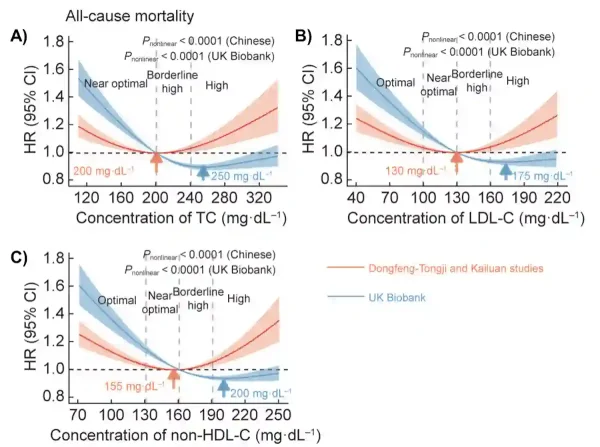
Figure 2. A cholesterol paradox: risk may rise at both extremes. These curves show the relationship between (A) total cholesterol (TC), (B) LDL cholesterol and (C) non-HDL cholesterol with mortality risk from any cause. In the Chinese population (orange line), the pattern was U-shaped: mortality risk was higher when cholesterol was either very low or very high. In the British population (blue line), very low cholesterol was also linked to higher all-cause mortality, but not high cholesterol. The lowest-risk or optimal levels also differed between populations: around 200 mg/dL for TC, 130 mg/dL for LDL cholesterol and 155 mg/dL for non-HDL cholesterol in the Chinese population, compared with around 250 mg/dL, 175 mg/dL and 200 mg/dL in the British population. Source: Adapted from Jiang et al. (2025), Engineering.
(Note: HR, hazard ratio, is a measure of relative risk over time. A value above 1.0 means higher risk, while a value below 1.0 means lower risk. For example, an HR of 1.4 means the risk is 40% higher, while an HR of 0.8 means the risk is 20% lower.)
Overall, the study points to a cholesterol paradox: the risk may run in both directions. When it is too high, the danger appears mainly in cardiovascular disease. But when it is too low, or falls sharply over time naturally, it may signal a different kind of risk that is linked to cancer mortality and poorer overall survival rather than to clogged arteries.
“[Our] study probably represents the most rigorous and comprehensive analysis of cholesterol-related mortality to date,” Jiang et al. wrote. “These findings underscore the dual risk pattern of cholesterol levels, emphasising that both high and low levels may be harmful depending on death causes and suggesting the need for individualised lipid management strategies.” Finally, the authors cautioned that the health implications of low cholesterol in other populations remain a largely overlooked area, one that may signal premature mortality.
What is the Link Between Low Cholesterol and Mortality?
The cholesterol paradox is not entirely new. As early as 1992, the U.S. National Heart, Lung and Blood Institute conference reviewed 19 cohort studies and noted that total cholesterol sometimes showed a U-shaped relationship with mortality. Higher cholesterol was linked to cardiovascular deaths, and lower cholesterol to non-cardiovascular deaths. However, the conference could not determine whether low cholesterol was harmful in itself. Many suspected that the association may reflect pre-existing diseases or other underlying factors.
Since then, several large cohorts have reported a similar pattern. For example, the Copenhagen General Population Study also found a U-shaped association between LDL cholesterol and all-cause mortality: both very low (<70 mg/dL) and very high LDL cholesterol (>189 mg/dL) were linked to higher mortality, while the lowest risk was seen around 140 mg/dL. Similar results have been reported with population studies in the U.S., Canada and South Korea.
So, Jiang et al. did not discover the cholesterol paradox from scratch. What they contributed was methodological rigour. They designed the analysis to minimise the most obvious sources of bias, removing participants whose cholesterol levels might already have been distorted by pre-existing disease, frailty, medication use or impending death. They also implemented cross-population comparison and longitudinal analysis of cholesterol changes. These strengths made the cholesterol paradox a more well-established phenomenon.
However, this raises the obvious question: why would low cholesterol be linked to higher mortality or premature death at all?
One possibility is that low cholesterol may simply be a result of poor health. Hidden cancer, liver dysfunction or frailty can alter lipid metabolism before a diagnosis becomes apparent. Growing tumours, for instance, often alter cholesterol metabolism by increasing cholesterol synthesis or uptake, because rapidly dividing cancer cells need cholesterol for membrane formation and continued growth. However, the study by Jiang et al. excluded people with major pre-existing diseases (including cancer) and low body mass index (indicating frailty), as well as those who died within the first two years of follow-up. These steps reduce the likelihood that low cholesterol is solely due to a serious underlying illness.
Another possibility is that cholesterol is part of the body’s cellular infrastructure. It stabilises cell membranes, provides the raw material for hormone production and helps organise immune responses. In fact, many immune receptors do not simply float randomly across the cell membrane. Instead, they gather in cholesterol-rich areas of the cell membrane called lipid rafts, where signalling molecules are brought close enough to coordinate a response. Laboratory studies suggest that lipid rafts help coordinate the anti-tumour activity of immune cells as well. Moreover, these lipid rafts are involved in pathogen recognition, insulin signalling and disease-related pathways (Figure 3). As such, very low or naturally falling cholesterol may reflect reduced biological reserve.
Evidently, low cholesterol is not always the same as healthy cholesterol. In some people, very low or falling cholesterol may reflect hidden disease, frailty or reduced biological reserve. The challenge, then, is not to abandon cholesterol-lowering in those who may need it, but to ask whether current guidelines have focused too narrowly on cardiovascular risk while overlooking the broader biological context in which cholesterol exists.
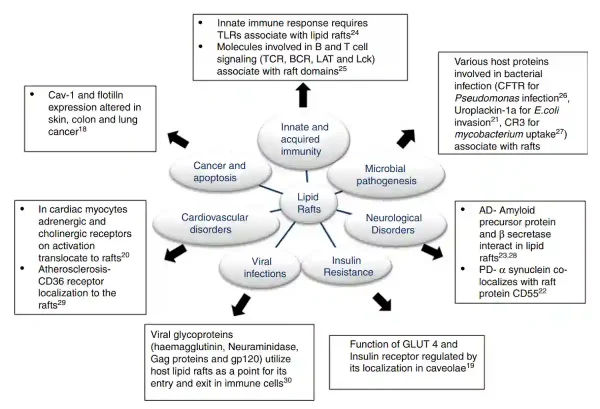
Figure 3. Lipid rafts are cholesterol-rich regions of the cell membrane where receptors and signalling molecules gather. This helps cells coordinate many biological responses, including immune activation, pathogen recognition, insulin signalling and disease-related pathways. Source: Varshney et al. (2016), Immunology.r. Overall, the test can identify a wide range of cancers with generally strong performance, though accuracy varies by cancer type. Source: Bao et al. (2025), Nature Medicine.
Cholesterol Targets Need Context
Current cholesterol guidelines are not wrong, but they may be incomplete if treated as a universal biological rule. The Centres for Disease Control and Prevention (CDC) lists the desirable levels of total and LDL cholesterol at about 150 mg/dL and 100 mg/dL, respectively. However, Jiang et al.’s findings suggest these targets may not fully capture what cholesterol means for overall survival. In their study, the lowest mortality-risk levels for total and LDL cholesterol were around 200 mg/dL and 130 mg/dL in Chinese adults, but around 250 mg/dL and 175 mg/dL in British adults. This fits a broader global pattern: cholesterol levels have historically been higher in many Western populations than in many Asian and African populations.
That does not mean the difference is simply racial. Cholesterol levels are also shaped by genetics, diet, body composition, medication use, age, sex and pre-existing diseases. The message is not to ignore very high LDL in people at cardiovascular risk. The cholesterol paradox suggests “lower is better” may be too simplistic. The better question is: what does this cholesterol level mean for this particular person?