

Chemo brain — the memory and concentration problems that affect up to 75% of chemotherapy patients — has no reliable drug treatment. But in one of the largest trials ever run on the problem, a simple six-week walking and resistance-band program reduced cognitive decline, likely by helping the immune system regulate inflammation.
One of the most common things patients say during chemotherapy is not about pain. It is the loss of mental clarity. They forget appointments, lose track of conversations and struggle to process what they read. This is known as chemotherapy-related cognitive impairment or “chemo brain,” which affects up to 75% of patients during chemotherapy. More concerningly, chemo brain can persist for years after chemotherapy, impairing how survivors think, work, and function in daily life. Yet despite its prevalence, we still lack a reliable way to treat it. However, that may be starting to change, not with another drug though, but with exercise, per findings from one of the largest randomised trials ever conducted on this problem.
A Different Approach: Exercise as Therapy
The most interesting part of this story is what the scientists at Wilmot Cancer Institute, University of Rochester Medical Centre, U.S., chose to test. Instead of adding another drug to the list, Karen Mustian, Ph.D. and colleagues tried something far simpler: exercise.
Until recently, the evidence for exercise as a treatment for chemo brain was thin. Most studies were small and methodologically inconsistent. There had been no nationwide, multicentre phase III randomised controlled trials – the kind designed to truly test an intervention at scale. Published in the Journal of the National Comprehensive Cancer Network (JNCCN) in 2026, Mustian et al. addressed this gap by recruiting 693 patients from 20 community oncology practices across the U.S. – most participants were females with breast cancer.
Patients starting chemotherapy were randomly assigned to usual care or a six-week Exercise for Cancer Patients (EXCAP) programme consisting of personalised, home-based walking and resistance-band exercises of low-to-moderate intensity. At baseline, both groups were similarly active, walking about 4,000 steps per day. Once chemotherapy began, however, their activity patterns diverged. The daily step counts of participants in the usual care fell by more than half. In contrast, those in the exercise programme maintained their step counts and completed resistance training about three times per week, with sessions averaging 25 minutes. Meanwhile, very few patients in the usual care group engaged in any resistance training at all.
Across the study, all patients experienced some degree of chemo brain or cognitive decline during chemotherapy, which was expected. However, those who followed the exercise programme declined less severely than those following the usual care:
- Lower overall cognitive impairment
- Better perceived cognitive function
- Fewer signs of cognitive decline noticed by others
- Reduced mental fatigue
Basically, patients who exercised had fewer cognitive problems, and even people around them noticed the difference (Figure 1). In a condition often dismissed as subjective, this kind of consistency across self-report, external observation and formal testing is hard to ignore. After completing the programme, most participants (92%) also reported a more positive attitude toward exercise. Nearly all of them (97%) said they would recommend it to other patients undergoing chemotherapy to help manage cognitive symptoms.
One notable caveat of this clinical trial is that these benefits were not observed in patients receiving longer (3- or 4-week) chemotherapy cycles, despite similar adherence to the exercise programme as those on shorter (2-week) chemotherapy cycles. Although the precise reason remains unclear, Mustian et al. hypothesised that patients on longer cycles may be sicker and require a higher or longer dose of exercise to see cognitive benefits.
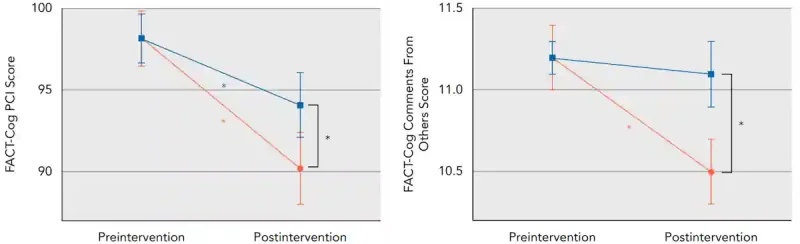
Figure 1. Exercise helps preserve cognitive function during chemotherapy. The blue line represents patients who followed the exercise programme, while the red line represents patients receiving usual care. Left: Patients undergoing chemotherapy experienced a decline in cognitive function over time, but those who followed the exercise programme declined significantly less. Right: Family and friends were also less likely to notice cognitive problems in patients who exercised. Source: Adapted from Mustian et al. (2026), Journal of the National Comprehensive Cancer Network.
Why Would Exercise Help the Brain at All?
At first glance, it seems almost too simple to matter. After all, how could walking and light resistance training influence something as complex as cognition? The answer may lie in how both chemotherapy and exercise affect the immune system, not just the brain.
When chemotherapy causes cell damage and stress, the body releases inflammatory signals into the bloodstream. These include cytokines such as interleukin-6 (IL-6), tumour necrosis factor-alpha (TNF-α) and interferon (IFN), which can reach the brain by crossing the blood–brain barrier. Once inside the brain, these cytokines set off a cascade of increased neuroinflammation and oxidative stress, which disrupt neurotransmission, neurogenesis and neuroplasticity. Multiple studies have, indeed, linked higher levels of inflammatory cytokines to worse cognitive outcomes during and after chemotherapy.
Unlike drugs that attempt to block inflammation, exercise appears to retrain the immune system. When you exercise, your body briefly increases pro-inflammatory signals, but this is quickly followed by a coordinated anti-inflammatory response, even in patients undergoing chemotherapy. A key example is IL-6. Although it is typically pro-inflammatory, IL-6 released by skeletal muscles during exercise triggers anti-inflammatory pathways, such as increasing IL-10 and IL-1 receptor antagonist (IL-1RA) (Figure 2). Over time, repeated exercise helps restore the body’s ability to regulate its own immune activity.
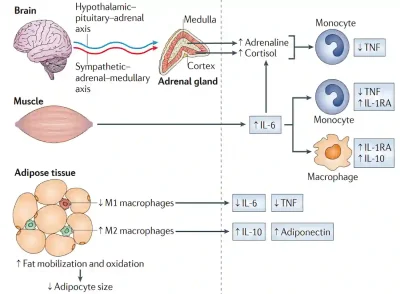
Figure 2. How exercise helps the body control inflammation. During physical activity, muscles release signalling molecules like interleukin-6 (IL-6), which, in turn, stimulate anti-inflammatory pathways. At the same time, stress hormones such as adrenaline and cortisol are released, helping to suppress harmful inflammatory signals like tumour necrosis factor (TNF). In fat tissue, exercise shifts immune cells from a more inflammatory state (M1) to a more protective, anti-inflammatory state (M2), while also reducing fat size and improving metabolism. Source: Gleeson et al. (2026), Nature Reviews Immunology.
In the clinical trial, Mustian et al. observed this pattern as well. Patients who exercised showed a more balanced inflammatory response. Rather than examining each cytokine alone, Mustian et al. used a statistical approach called structural equation modelling to capture an overall “inflammatory response” based on the activities of multiple cytokines, including IL-1β, IL-6, IL-8, IL-10, IFN-γ and soluble TNF receptor 1 (sTNFR1). Patients who exercised, demonstrated a more coordinated cytokine response – reflected by simultaneous changes in both pro- and anti-inflammatory markers – and tended to have better cognitive outcomes.
Mustian et al. then concluded, “Oncologists should consider training staff in their clinics or referring patients to qualified exercise professionals in their communities to provide individually tailored exercise prescriptions that combine walking and resistance band exercises to reduce [cognitive impairment] and mental fatigue in patients receiving chemotherapy.”
Exercise Helps More Than the Brain
The benefit of exercise is not limited to the brain alone. For instance, a 2026 meta-analysis of 21 clinical trials involving breast cancer patients reported that exercise improved overall quality of life during chemotherapy. This includes better physical function, mental health and energy levels. These benefits were observed regardless of exercise type (aerobic, resistance or combined training) and geography (America, Europe or Asia). A broader 2024 systematic review reached a similar conclusion across cancer types: that exercise during chemotherapy is safe and improves body composition, fitness and quality of life.
Recent meta-analyses also indicate that exercise can mitigate symptoms of chemotherapy-induced peripheral neuropathy (CIPN) and cancer-related fatigue (CRF). Both CIPN and CRF are common adverse effects of chemotherapy, as previously covered at Integrative Cancer Care. Some evidence suggests that exercise may improve cardiometabolic functions and treatment tolerance, helping patients be more likely to complete cancer therapy and return to work earlier. Longitudinal research further shows that exercise reduces the risk of cancer recurrence and death among cancer survivors over 5-8 years of follow-up (Figure 3).
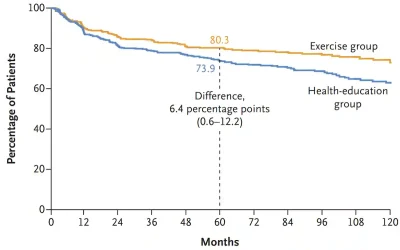
Figure 3. Exercise improves cancer outcomes after chemotherapy. Patients who followed a structured exercise programme were more likely to remain cancer-free over time compared to those who received health education alone. At 5 years, 80.3% of patients in the exercise group had no cancer recurrence, new cancer or death, compared to 73.9% in the control group – a meaningful difference of 6.4 percentage points. Source: Courneya et al. (2025), New England Journal of Medicine.
Therefore, apart from chemo brain, research increasingly suggests that physical activity can support several areas that chemotherapy erodes: quality of life, fitness, symptom burden, treatment tolerance and even long-term health. This is also why cancer guidelines now treat exercise as a legitimate part of supportive care. For example, the American Cancer Society notes that, for most people, exercise is safe and helpful before, during and after cancer therapy. The European Society for Medical Oncology (ESMO) and European Cancer Patient Coalition (ECPC) also recommend at least 150 minutes of moderate activity per week to help reduce anxiety, fatigue and stress, with walking programs generally safe for most survivors.
Sometimes, the most powerful interventions are not new drugs but new ways of understanding the body and working with it.