

After surgery and chemotherapy for colon cancer, strategies to prevent recurrence include structured exercise, targeted aspirin, ctDNA testing, vitamin D correction, healthy diet and selected phytotherapy. In the CHALLENGE trial, exercise increased overall survival from 83% to 90%. Aspirin reduced recurrence in PI3K-altered tumours, while ctDNA refined risk assessment. These options help survivors prioritise evidence-based aftercare and long-term recovery.
A patient had surgery for colon cancer. Even though the tumour was removed, cancer cells were detected in a nearby lymph node, placing the disease at stage III. The patient then received adjuvant chemotherapy to eliminate the remaining cancer cells that surgery had left behind. But after chemotherapy ends, many survivors wonder if there is anything else they can do to lower the risk of cancer recurrence or recover from therapy-related side effects. In this article, we review several aftercare strategies based on what the research actually shows.
Before we continue, let us clarify the type of evidence prioritised. We focused on randomised clinical trials (RCTs), which provide the strongest evidence of cause and effect. We also included prospective cohort studies that follow patients over time. We avoided retrospective observational studies, which look back at existing records, because the groups being compared may not be truly alike. For example, people who received an intervention may already be healthier, wealthier or better supported – a problem called confounding.
Colorectal Cancer Follow-up Care: 6 Evidence-Based Strategies
Strategy #1: Structured Exercise
The top strategy is one of the simplest: exercise. The recent CHALLENGE RCT enrolled 889 colon cancer survivors who had completed surgery and adjuvant chemotherapy. About 90% had stage III disease. Participants were randomly assigned to receive either health-education materials alone or a three-year exercise programme.
The target was to add at least 10 metabolic equivalent task-hours of recreational activity each week – roughly equivalent to 45-60 minutes of brisk walking three or four times weekly. Participants received guidance from a certified physical-activity consultant, supervised sessions during the first six months and continuing behavioural support over three years. They could choose the type, frequency and duration of aerobic activity, allowing the programme to be adapted to individual preferences for long-term compliance.
After a median follow-up of 7.9 years, five-year disease-free survival was 80.3% with exercise versus 73.9% with health education – an absolute difference of 6.4 percentage points. Overall survival also favoured exercise: eight-year survival was 90.3% versus 83.2% (Figure 1).
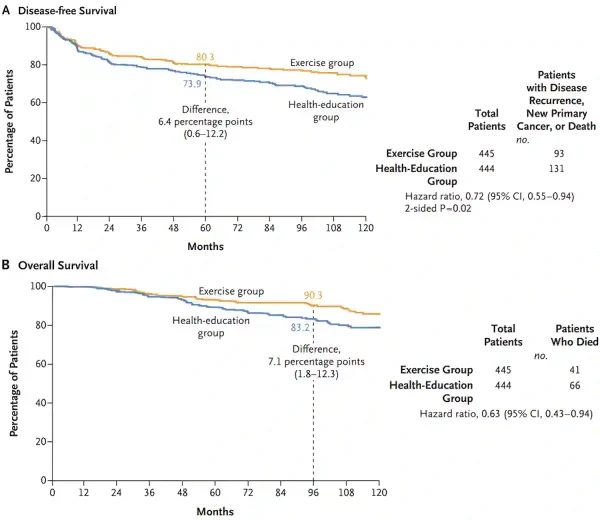
Figure 1. Structured exercise after therapy improved long-term outcomes in patients with colon cancer in the CHALLENGE RCT. (A) After five years, 80.3% of patients in the exercise group remained alive without cancer recurrence or a new primary cancer, compared with 73.9% in the health-education group – a difference of 6.4 percentage points. (B) At eight years, overall survival was 90.3% with exercise versus 83.2% with health education, a difference of 7.1 percentage points. Source: Courneya et al. (2026), New England Journal of Medicine.
Interestingly, the benefit did not depend on weight loss. Body weight and waist circumference changed little between the groups, even though cardiorespiratory fitness, walking capacity and physical functioning improved in the structured exercise group. This suggests that exercise may influence cancer outcomes through mechanisms other than weight control, such as improved insulin sensitivity, reduced inflammation and stronger immune surveillance.
Notably, exercise was not entirely risk-free. In this RCT, musculoskeletal complaints were more common with structured exercise than health education, affecting 18.5% versus 11.5% of participants. However, most musculoskeletal events were mild or moderate. Grade 3 or higher events only occurred in three exercise participants (0.7%) and one education participant (0.2%). The main safety signal was thus a modest increase in non-serious muscle or joint complaints, rather than a substantial risk of serious injury.
Exercise may also support recovery. A 2026 meta-analysis of 22 RCTs involving 1,676 colorectal cancer survivors found that exercise improved quality of life and reduced fatigue, depression and anxiety. Benefits appeared most consistent with structured, moderate-intensity programmes involving professional or remote supervision. A broader 2025 umbrella review across different cancers also found moderate- to high-certainty evidence that exercise can improve physical function, quality of life and therapy-related adverse effects, such as cardiac toxicity, cognitive impairment, neuropathy and dyspnoea (breathing difficulties).
Exercise may also be useful during chemotherapy, although this evidence is more limited. A systematic review of eight RCTs involving 552 colorectal cancer patients on chemotherapy found small improvements in physical function and quality of life, alongside a moderate reduction in fatigue. No exercise-related adverse events were reported. However, most RCTs were small and excluded frailer patients. So, physical activity during therapy should be adjusted to symptoms and individual capacity, as well as discussed with the oncology team.
Overall, the evidence highly favours structured exercise for cancer patients who are medically able to exercise. The American Cancer Society likewise recommends tailored physical activity from the time of diagnosis. For most survivors, the long-term goal is to gradually build towards 150-300 minutes of moderate-intensity activity or 75-150 minutes of vigorous activity per week, plus muscle-strengthening exercise on at least two days each week.
Strategy #2: Aspirin for PI3K-Altered Tumours
This strategy is more selective. Aspirin may reduce recurrence in patients whose colorectal tumours carry mutations in the PI3K signalling pathway, which is involved in cell survival. The rationale is that PI3K-altered cancer cells may rely more on cyclooxygenase-2 (COX-2) inflammatory signals to grow and survive. By blocking COX-2, aspirin may weaken the capability of residual cancer cells to survive, spread or recur.
The major evidence comes from the ALASCCA RCT involving patients with resected stage II-III colon cancer or stage I-III rectal cancer. Tumours were screened for hotspot mutations in PIK3CA, PIK3R1 or PTEN genes. Such mutations were found in 1,103 of 2,980 patients (~37%) with complete genomic results. A total of 626 eligible patients were then randomly assigned to receive aspirin (160 mg) or placebo once daily for three years after surgery. Aspirin could also be given alongside or after adjuvant chemotherapy, according to local practice.
Among patients with PIK3CA hotspot mutations (Group A), the three-year recurrence rate was 7.7% in those taking aspirin compared with 14.1% of those taking placebo. The pattern was similar in patients with other PI3K-pathway alterations (Group B): recurrence occurred in 7.7% with aspirin versus 16.8% with placebo (Figure 2). Hence, aspirin led to roughly half as many recurrences. When both molecular groups were combined, the RCT estimated that treating 13 patients for three years would prevent one recurrence. In the stage-specific analysis, the number needed to treat (NNT) was 42 for stage II colon cancer, 9 for stage III colon cancer, 22 for stage I rectal cancer, 12 for stage II rectal cancer and 6 for stage III rectal cancer.
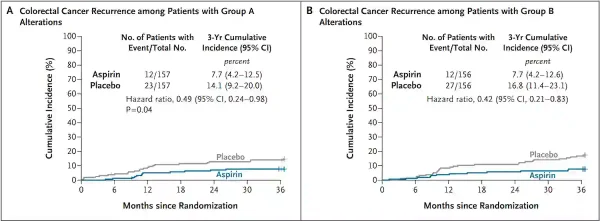
Figure 2. Aspirin reduced colorectal cancer recurrence in patients with PI3K-altered tumours in the ALASCCA RCT. (A) Among patients with common PI3KCA hotspot mutations, the three-year recurrence rate was 7.7% with aspirin versus 14.1% with placebo. (B) Among those with other PI3K-pathway alterations, recurrence was 7.7% versus 16.8%. In both panels, the lower blue line shows that fewer recurrences accumulated over time in the aspirin group. Source: Martling et al. (2025), New England Journal of Medicine.
One caution is that aspirin is not risk-free. Severe adverse events occurred in 16.8% of aspirin recipients versus 11.6% of placebo recipients, with gastrointestinal complications more common in the aspirin group. However, life-threatening events were equally rare in both groups, at 0.6%, although one death in the aspirin group was considered possibly aspirin-related. Encouragingly, five-year overall survival still favoured aspirin (91.6% vs 90.1% in group A and 93.0% vs 89.7% in group B), but neither difference was statistically significant. This is primarily because the RCT’s sample size was powered to detect differences in recurrence rather than mortality, and too few deaths had occurred for a reliable comparison.
So, the decision is not simply whether aspirin works, but whether its potential benefits outweigh the bleeding and other risks for a particular patient. Aspirin may be unsuitable for people with previous gastrointestinal bleeding or peptic ulcers, active gastritis, low platelet counts, aspirin allergy, uncontrolled high blood pressure or severe kidney disease. It is also not recommended for patients already taking anticoagulants or other antiplatelet drugs.
The 2026 National Comprehensive Cancer Network (NCCN) guidelines now recommend PI3K-pathway testing in resected stage II and III colon cancer when considering aspirin for reducing recurrence risk. Aspirin is thus one of the most compelling examples of precision aftercare in colon cancer. It is an inexpensive, accessible drug that may halve the recurrence rate in a subset of patients with PI3K-altered tumours. However, it should only be considered after appropriate tumour genetic testing and consultation with the oncology team.
Strategy #3: Circulating Tumour DNA (ctDNA) Testing
Circulating tumour DNA (ctDNA) refers to tiny fragments of cancer-derived DNA that leak from the original tumour into the bloodstream. After surgery, ctDNA positivity may reveal microscopic residual disease that is still too small to appear on imaging scans.
The 2025 DYNAMIC-III RCT provides the main evidence for the utility of ctDNA. This RCT enrolled 968 patients with resected stage III colon cancer. CtDNA was measured five to six weeks after surgery, after which patients were randomised to ctDNA-guided or standard management. In the ctDNA-guided group, ctDNA-negative patients received less intensive chemotherapy, while ctDNA-positive patients received more intensive chemotherapy.
The result was highly informative for prognosis. At three years, 87% of ctDNA-negative patients remained free from recurrence, compared with only 49% of ctDNA-positive patients. Among patients who were initially ctDNA-positive, clinical outcomes depended strongly on whether chemotherapy cleared the ctDNA: three-year recurrence-free survival was 79% when ctDNA disappeared, but only 14% when ctDNA remained detectable after chemotherapy.
The harder question is whether ctDNA should guide chemotherapy. In this RCT, ctDNA-negative patients received less intensive chemotherapy, which reduced oxaliplatin use from 88.6% to 34.8% and chemotherapy-related hospitalisation from 13.2% to 8.5%. However, three-year recurrence-free survival was slightly lower with ctDNA-guided de-escalation than standard management (85.3% vs 88.1%). So, the RCT narrowly failed to confirm that reducing chemotherapy was sufficiently safe. Meanwhile, escalating chemotherapy to ctDNA-positive patients also failed to improve outcomes: two-year recurrence-free survival was 51% with escalation versus 61% with standard management (Figure 3).
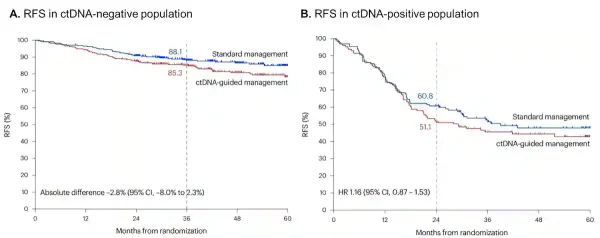
Figure 3. The proportion of patients remaining free from cancer recurrence over time in the DYNAMIC-III RCT. (A) Among ctDNA-negative patients, recurrence-free survival (RFS) at three years was 85.3% with de-escalated chemotherapy versus 88.1% with standard care. This difference was not statistically significant because the 95% confidence interval (95% CI) for the absolute difference crossed zero (−8.0% to 2.3%). (B) Among ctDNA-positive patients, escalating chemotherapy also did not significantly improve outcomes: two-year RFS was 51.1% versus 60.8% with standard management, but the 95% CI for the hazard ratio (HR) crossed 1.0 (0.87-1.53). Source: Tie et al. (2025), Nature Medicine.
Other studies point in the same direction. In a prospective cohort study of 1,039 patients with stage II-IV colorectal cancer, recurrence occurred in 61.4% of those who were ctDNA-positive four weeks after surgery, compared with 9.5% of those who were ctDNA-negative. Among ctDNA-positive patients, adjuvant chemotherapy was associated with substantially better outcomes. In contrast, no clear benefit of adjuvant chemotherapy was seen among ctDNA-negative patients. However, because chemotherapy was not randomly assigned, this study cannot prove that chemotherapy can safely be omitted when ctDNA is negative.
Another noteworthy study is the smaller, non-randomised PEGASUS RCT that used ctDNA to guide chemotherapy in 135 patients with stage III or high-risk stage II colon cancer. CtDNA-negative patients received capecitabine alone, while ctDNA-positive patients received CAPOX (capecitabine and oxaliplatin). Although 88% of ctDNA-negative patients remained disease-free at two years, the study missed its predefined benchmark for confirming that chemotherapy de-escalation was sufficiently safe. Among treated ctDNA-positive patients, the two-year relapse risk was still higher than in ctDNA-negative patients (61.5% vs 87.6%), indicating that ctDNA positivity remains a risk marker even after standard chemotherapy.
While ctDNA is a powerful marker of recurrence risk, it is not yet an established tool for modifying chemotherapy in colon cancer. A negative ctDNA result should not currently be used to de-escalate chemotherapy, as its benefit remains promising but uncertain. Meanwhile, a positive ctDNA result should prompt closer surveillance and RCT consideration rather than simply escalating chemotherapy, which does not appear to be beneficial.
Strategy #4: Correcting Vitamin D Deficiency
Vitamin D has attracted interest in colorectal cancer because laboratory studies suggest that its active form may inhibit cancer-cell growth and suppress pro-inflammatory signalling. The strongest clinical evidence comes from the AMATERASU RCT, which enrolled 417 patients after surgery for stage I–III digestive-tract cancers. Approximately 48% had colorectal cancer, and 30% had stage III disease. All patients with stage III colorectal cancer received adjuvant chemotherapy. Participants were randomly assigned to take vitamin D₃ at 2,000 IU per day or placebo, beginning two to four weeks after surgery, until the end of the RCT.
After five years, 77% of patients receiving vitamin D₃ remained alive without relapse, compared with 69% receiving placebo, but this difference was not statistically significant. Interestingly, a benefit appeared among patients whose baseline vitamin D levels were insufficient (20-40 ng/mL). In this subgroup, five-year relapse-free survival was 85% with vitamin D₃ versus 71% with placebo. No benefit was seen among patients with deficient vitamin D levels (<20 ng/mL). The investigators then suggested that 2,000 IU of vitamin D₃ per day may have been inadequate to correct more severe deficiency (Figure 4).
Long-term vitamin D₃ supplementation was generally well tolerated in this RCT. Fractures occurred in 1.3% of the vitamin D₃ group versus 3.4% with placebo, while urinary stones occurred in 0.9% versus none. No hypercalcaemia was reported.
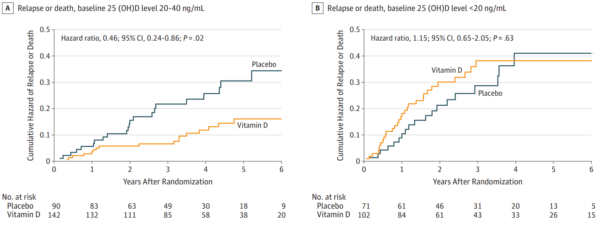
Figure 4. Vitamin D₃ supplementation appeared beneficial in patients with insufficient vitamin D levels of 20-40 ng/mL at baseline. (A) In this subgroup, patients taking vitamin D₃ had a 54% lower risk of relapse or death than those taking placebo. (B) Among patients with more severe vitamin D deficiency below 20 ng/mL, supplementation did not improve outcomes. Source: Urashima et al. (2019), Journal of the American Medical Association (JAMA).
Observational evidence also supports vitamin D as a marker of improved survival. In one study of 1,437 patients with stage III colon cancer enrolled in a large chemotherapy RCT, severe vitamin D deficiency (below 12 ng/mL) was present in 13%. Compared with deficient patients, those with non-deficient levels had a 32-43% lower risk of recurrence or death. A larger prospective cohort study of more than 6,000 colorectal cancer patients also found better cancer-specific and overall survival among those with higher vitamin D levels.
Altogether, while vitamin D₃ supplementation is not an established treatment for preventing colon cancer recurrence, checking vitamin D levels and correcting deficiency is reasonable. Standard replacement is inexpensive and generally safe. Moreover, vitamin D is important for bone, muscle, hormonal and immunological health.
Strategy #5: Ensuring a Healthy Diet
Unlike the previous strategies, no RCT has shown that a specific diet can help prevent colon cancer from returning. The best evidence comes from prospective observational studies, in which patients reported their eating habits before any recurrence occurred. One major study followed 1,009 patients with resected stage III colon cancer who were participating in the Alliance chemotherapy RCT. Instead of assigning different diets, this study observed how patients with different eating patterns in the RCT fared over time.
The study identified two dietary patterns. The “prudent” pattern included more vegetables, fruits, whole grains, legumes, poultry and fish. The “Western” pattern included more red and processed meats, refined grains, desserts, high-fat dairy products and French fries. Compared with patients who ate the least Western-style diet, those eating the most had more than three times the risk of recurrence or death (Figure 5). In contrast, greater adherence to the prudent pattern was not significantly associated with cancer recurrence.
This does not mean that vegetables, fruits or whole grains are unhelpful. Rather, the study was better at detecting the potential harm of an overall Western dietary pattern than the benefit of any single “healthy” pattern. The association also persisted after adjustment for tumour stage, lymph-node involvement, chemotherapy, body mass index, physical activity, calorie intake and weight change. Nevertheless, this remained an observational study based on self-reported diet, so it cannot prove that changing diet after chemotherapy directly lowers recurrence risk.
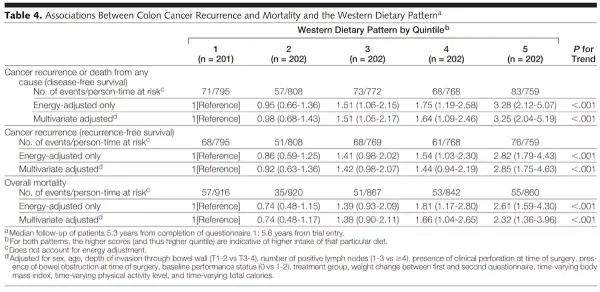
Figure 5. Western dietary patterns and outcomes after stage III colon cancer. Patients were divided into five groups, from the lowest to the highest intake of a Western-style diet. After adjustment for tumour, treatment and lifestyle factors, those in the highest group had 3.25 times the risk of recurrence or death, 2.85 times the risk of recurrence and 2.32 times the risk of death compared with those in the lowest group. Risk generally increased as Western-diet intake rose. Source: Meyerhardt et al. (2007), Journal of the American Medical Association (JAMA).
Two similar analyses of the same Alliance RCT of stage III colon cancer examined specific foods. In one study, drinking four or more cups of coffee per day was associated with a 42% lower risk of recurrence or death than drinking none. Another analysis reported that patients who consumed at least two servings of nuts per week had a 42% lower risk of recurrence or death. The association was mainly seen with tree nuts (e.g., walnuts, almonds and cashews), rather than peanuts or peanut butter. Plausible reasons could be that coffee and nuts contain phytochemicals that may improve insulin regulation, inflammation and oxidative balance.
Avoiding a Western dietary pattern is a sensible, low-risk strategy, even though we lack causal evidence that it directly prevents recurrence. The American Cancer Society recommends a plant-rich eating pattern with healthy protein sources, such as fish, poultry or lentils. It also advises limiting red and processed meats, refined grains, sugars, alcohol and highly processed foods. Maintaining a healthy bodyweight is endorsed as well.
Strategy #6: Complementary Phytotherapy
Phytotherapy refers to the therapeutic use of plant-derived compounds. It typically falls under the category of complementary medicine used alongside conventional therapy. Most of the RCTs involving phytotherapy examined whether such products could ease therapy-related symptoms. A few RCTs also tested whether they could prevent cancer recurrence.
Several examples include:
- Curcumin: A small RCT tested curcumin (2 g per day) alongside oxaliplatin-based chemotherapy in 28 patients with metastatic colorectal cancer. Curcumin was safe, but it did not improve quality of life or reduce neurotoxicity. Another RCT found that curcumin (3 mg/kg twice a day) reduced the incidence of vincristine-induced neuropathy in children with leukaemia (39.4% vs 70.0% with placebo). However, vincristine neuropathy differs from the nerve damage caused by oxaliplatin.
- Ginseng: In an RCT of 438 colorectal cancer patients receiving chemotherapy, Korean red ginseng (2 g per day), a processed form of Panax ginseng, led to improvements in cancer-related fatigue, particularly mood and walking ability (Figure 6). The safety profile of ginseng was favourable overall. Smaller studies with chemotherapy-treated patients have also reported improvements in mood, sleep or immunological markers with ginseng. The U.S. National Cancer Institute even listed ginseng as a potential treatment strategy for fatigue, although evidence remains non-definitive.
- Green tea extract: A large RCT tested the EGCG green tea extract (150 mg twice daily) in people who had colorectal adenomas removed. New adenomas developed in 51.1% of the green tea group versus 55.7% with placebo – a difference that was not statistically significant. A possible benefit appeared only in men (52.9% vs 60.4%). Since adenoma formation is not the same as invasive cancer recurrence, this provides weak evidence for the chemopreventive potential of green tea extract.
- Turkey tail mushroom extract (PSK): PSK was studied mainly in Japan as an adjuvant alongside older fluoropyrimidine chemotherapy. In a 2004 RCT, five-year disease-free survival in patients with stage II/III colorectal cancer was higher with PSK at 3 g per day (73.0% vs 58.8%). A 2017 meta-analysis of 23 gastrointestinal cancer RCTs also favoured PSK for improving disease-free and overall survival. While a newer 2024 RCT of stage II/III colorectal cancer found higher three-year disease-free survival when PSK (3 g per day) was added for six months (82.2% vs 72.5%), this effect missed statistical significance. However, severe adverse events were slightly less common with PSK, suggesting that PSK may help patients better tolerate therapy.
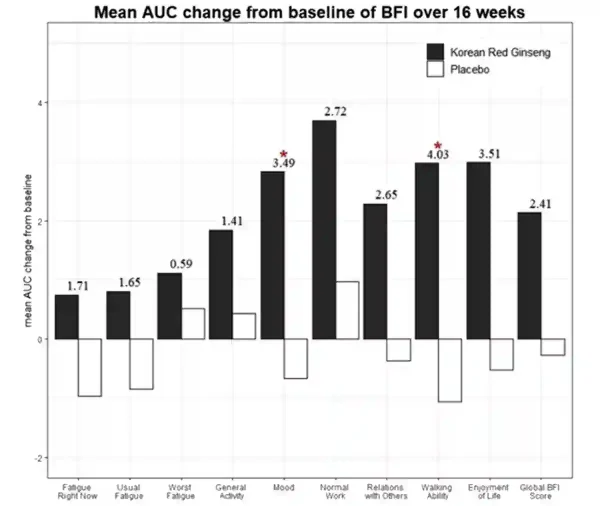
Figure 6. Korean red ginseng may help ease cancer-related fatigue during chemotherapy. Over 16 weeks, patients taking Korean red ginseng generally reported less fatigue-related decline than those taking placebo. Improvements were statistically significant for mood and walking ability, while the overall fatigue score and other measures showed favourable trends. Source: Kim et al. (2020), European Journal of Cancer.
Overall, phytotherapy is best viewed as a possible way to relieve symptoms, rather than a proven method to prevent recurrence. For colon cancer, ginseng has the most relevant evidence for reducing cancer-related fatigue, while curcumin has indirect evidence for preventing chemotherapy-induced neuropathy. Green tea and PSK extracts may help with recurrence prevention, but the evidence remains uncertain. Phytotherapy, therefore, represents a low-risk strategy with potential upsides, but its use should be discussed with the oncology team.
Closing Remarks
For many patients, completing therapy is only one step in the journey. Aftercare may further improve outcomes, especially when it is personalised to each patient. For colon cancer, structured exercise currently has the clearest benefit, while aspirin is promising for patients with PI3K-altered tumours. CtDNA is a strong marker for recurrence risk, but it should not be used on its own to change chemotherapy plans yet. Correcting vitamin D deficiency, following a healthy diet and considering selected phytotherapies are also generally low-risk strategies that may support both recurrence prevention and recovery from therapy-related side effects, although the evidence is less certain. Lastly, continued surveillance is equally important. Carcinoembryonic antigen (CEA) blood tests, computed tomography (CT) scans and colonoscopy do not prevent recurrence, but may detect it while further therapy is still possible. Patients should therefore attend their recommended follow-up appointments.