

Conventionally, a cancer biopsy meant extracting a physical sample from the tumour itself. Liquid biopsy changed that idea by showing that cancer can also be read through the blood. At Integrative Cancer Care, we recognised this potential early. In 2021 and 2023, we highlighted how a simple blood draw could offer a less invasive way to sample tumour material, capture tumour heterogeneity, and monitor cancer over time. Since then, the field has moved even further. New research shows that liquid biopsy can track tumour evolution in real time, predict recurrence before imaging scans can see it, and even support multi-cancer early detection.
Tracking Tumour Evolution in Real Time
Cancer is typically managed using a static model: a biopsy is taken at diagnosis, and that sample guides therapy decisions. Cancer, however, is anything but static. Tumours are made up of genetically diverse cells capable of evolving, especially under the survival pressure of anticancer therapies. A traditional tissue biopsy, taken from one site at one moment in time, can therefore miss important tumour changes. As a result, therapy decisions may be based on biological information that is already outdated by the time therapy begins or progresses.
This is where liquid biopsy comes into play. By analysing circulating tumour DNA (ctDNA) in the blood, physicians can gain a real-time view of cancer behaviour, including its evolving resistance to therapy. A 2026 study supports this approach. In over 1,700 patients with metastatic castration-resistant prostate cancer (mCRPC), ctDNA testing before and after therapy managed to reveal how tumours adapt under therapeutic pressure. (mCRPC refers to prostate cancer that has spread and no longer responds to hormone therapy.)
Across major therapy types, including hormone therapy, targeted therapy and chemotherapy, tumours consistently accumulated new mutations during therapy. Some of these mutations restored DNA repair or disrupted tumour suppressor genes, making the cancer harder to control. Particularly important were mutations in the androgen receptor, which allowed prostate tumours to bypass therapy and continue growing. Patients whose tumours developed these androgen receptor mutations also experienced worse outcomes, including shorter survival, faster disease progression, and earlier need for additional therapy.
“Serial ctDNA testing gives us a moving picture, not a snapshot,” the study lead author Chinmay T. Jani, M.D., a haematologist at Sylvester Comprehensive Cancer Centre, said in a news release. “That has real implications for precision oncology.” That said, most studies mainly showed that serial liquid biopsy was informative. The more important question was whether acting on that information could improve clinical outcomes.
A clear success so far is the phase III clinical trial called SERENA-6 (not an acronym), involving patients with metastatic breast cancer who were receiving standard aromatase inhibitor (a hormone therapy) with CDK 4/6 inhibitor (a targeted therapy). The trial then sampled their blood every 2-3 months to detect emerging oestrogen receptor 1 (ESR1) mutations, a common early sign of resistance to hormonal therapy. Notably, these ESR1 mutations often appear months before cancer progression becomes visible on imaging scans.
In other words, the trial asked a very practical question: if a liquid biopsy detects early resistance, can physicians intervene before cancer growth becomes obvious?
In the SERENA-6 trial, more than 3,000 patients were screened. Of those, 315 who developed an early ESR1 mutation were randomly assigned either to (i) switch from the aromatase inhibitor to camizestrant while continuing the CDK4/6 inhibitor, or (ii) continue their original therapy regimen unchanged. Camizestrant is a next-generation hormone therapy for breast cancer that works by degrading oestrogen receptors, including those with mutated ESR1.
The results were encouraging. Patients who switched early to camizestrant had:
- Longer disease control (56% lower risk of progression or death; Figure 1).
- Longer preservation of quality of life (21.0 vs 6.4 months).
Thus, these studies show that liquid biopsy may do more than simply monitor cancer. It helps physicians anticipate where the disease is heading and, in some cases, intervene before that next step becomes clinically dangerous.
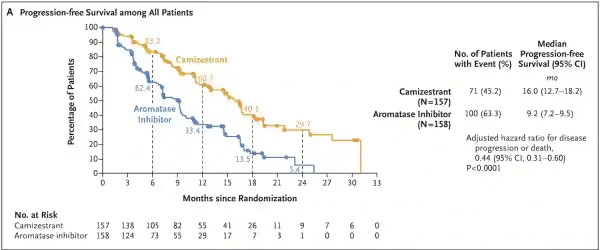
Figure 1. Early therapy changes based on liquid biopsy tests keep cancer under control for longer. Patients who switched early to camizestrant (orange line), guided by a liquid biopsy detecting early resistance, stayed progression-free for longer than those who remained on standard therapy (blue line). At 12 months, about 61% of patients in the camizestrant group had no disease progression, compared with 33% in the standard therapy group. Median progression-free survival was 16.0 versus 9.2 months, translating to a 56% lower risk of progression or death. Source: Bidard et al. (2025), New England Journal of Medicine.
Predicting Cancer Recurrence Before It Happens
By the time a tumour reappears on a scan, it has often been growing silently for months, if not longer. This delay has long limited our ability to intervene early, as physicians have traditionally relied on imaging scans or symptoms to confirm cancer recurrence.
Liquid biopsy may help us overcome this limitation. By detecting ctDNA in the blood, it becomes possible to identify molecular residual disease, i.e., small amounts of cancer that remain in the body after therapy but are still too small to be seen on imaging scans. Put simply, ctDNA may predict cancer recurrence long before it becomes clinically apparent.
A 2026 meta-analysis shows this clearly. Across 12 studies tracking patients with early-stage breast cancer, ctDNA predicted recurrence with an average sensitivity and specificity of around 80% and 78%, respectively. It correctly identified most patients who would relapse (sensitivity) while also ruling out recurrence in most who would not (specificity). More importantly, ctDNA detection preceded clinical relapse by an average of 15.5 months. In other words, for many patients, the liquid biopsy could reveal that cancer is returning more than a year before conventional methods would detect it.
However, this raises the question: when is the best time to measure ctDNA?
A new study presented at the 2026 European Breast Cancer Conference offers some insight. It focused on patients with HER2-positive breast cancer who were receiving neoadjuvant therapy to shrink the tumour before surgery. HER2 refers to human epidermal growth factor receptor 2, and HER2 overexpression drives more aggressive tumour growth.
Although ctDNA positivity fell during neoadjuvant therapy, patients who remained ctDNA-positive by the end were 3.5 times more likely to experience post-surgical recurrence over a median follow-up of seven years. This predictive signal persisted even in patients who achieved a good pathological response (i.e., little to no visible cancer after surgery), suggesting that ctDNA may capture residual risk that standard assessments can miss.
Another 2026 study in HER2-positive breast cancer also reported that residual ctDNA after neoadjuvant therapy led to a fivefold increased risk of recurrence, even after accounting for key factors like residual tumour size, lymph node status and pathological response. Notably, this study showed that this information may be actionable.
Among patients who remained ctDNA-positive, those who received trastuzumab emtansine (T-DM1) had better outcomes, with no recurrences observed during follow-up. In contrast, the recurrence-free survival rate was only 59% among those who did not receive T-DM1 (Figure 2). Serial liquid biopsy testing further showed that T-DM1 cleared ctDNA to undetectable levels in all patients, compared with 58% clearance in those who did not receive T-DM1. Hence, these findings suggest that liquid biopsy has helped pinpoint patients who may benefit from additional post-surgical therapy to reduce the risk of recurrence.
(T-DM1 is a form of antibody-drug conjugate therapy, which links a chemotherapeutic drug to a HER2-binding antibody. This allows chemotherapy to be delivered more directly to HER2-positive cancer cells, improving precision and reducing off-target toxicity. We have previously covered the innovative strategy of antibody-drug conjugate on our website, Integrative Cancer Care.)
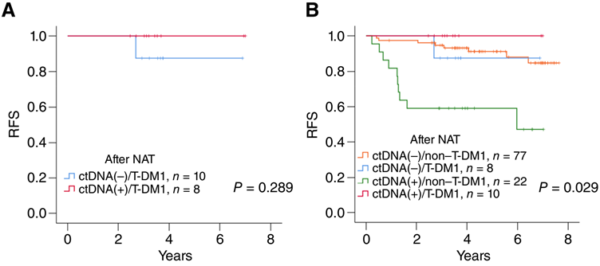
Figure 2. Liquid biopsy identified which breast cancer patients were likely to benefit from additional post-surgical therapy when ctDNA remained detectable after neoadjuvant therapy. (A) In patients treated with T-DM1, RFS outcomes were similar regardless of ctDNA status. (B) Patients who remained ctDNA-positive but did not receive T-DM1 had the worst RFS outcomes (green line). In contrast, ctDNA-positive patients who received T-DM1 (red line) had outcomes comparable to ctDNA-negative patients (orange and blue lines). Abbreviations: ctDNA, circulating tumour DNA; RFS, recurrence-free survival; T-DM1, trastuzumab emtansine. Source: Lin et al. (2026), Cancer Research Communications.
A similar concept has also been demonstrated in other cancers. For example, two separate clinical trials in 2025 and 2026 found that bladder cancer patients with detectable ctDNA after surgery benefited from early immunotherapy, while those who remain ctDNA-negative often have excellent outcomes without subsequent therapy. Liquid biopsy, therefore, identified who may benefit from earlier intervention and who may safely avoid unnecessary therapy.
Commercial liquid biopsy tests were used, including CancerTrack Analysis from DATAR Cancer Genetics, an India-headquartered company with international operations, including in Europe. This study illustrates how liquid biopsy can inform decisions in real-world scenarios, where patients are often more diverse and complex than those enrolled in clinical trials. Rising or persistent ctDNA levels may indicate residual disease or emerging relapse, prompting earlier intervention. In contrast, ctDNA clearance may suggest that therapy is effective and may warrant cautious therapy de-intensification to reduce unnecessary toxicity (Figure 3).
DATAR Cancer Genetics has also published studies applying liquid biopsy in specific diagnostic settings, including breast and prostate cancers. They have also worked in more challenging contexts such as pancreaticobiliary and brain cancers, where early diagnosis is often difficult. At Integrative Cancer Care, we have recommended such tests from this company in selected cases, reinforcing their real-world utility beyond clinical trials.
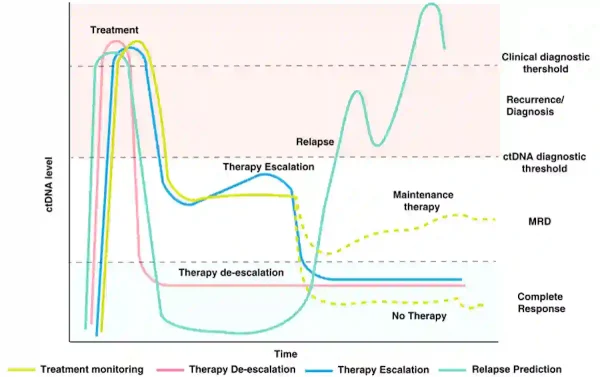
Figure 3. How liquid biopsy can guide cancer therapy decisions in real-world practice. Levels of circulating tumour DNA (ctDNA) can rise or fall depending on how the cancer responds to therapy. When ctDNA levels drop or become undetectable, this may indicate that therapy is working, allowing therapy de-escalation to avoid unnecessary toxicity. If ctDNA levels remain elevated or begin to rise again, this may indicate that cancer is still present as molecular residual disease (MRD) or returning, prompting earlier intervention or therapy escalation. Source: Limaye et al. (2025), The Journal of Liquid Biopsy.
Multi-cancer and Multi-disease Early Detection
One of the most ambitious goals in liquid biopsy research is pan-cancer or multi-cancer early detection. Instead of looking for one cancer at a time, these tests search the blood for molecular signals released by different cancers. The appeal is obvious. After all, current screening methods are only established for certain cancers, while many aggressive cancers still lack standard screening tests. Expectations must be grounded, however. These multi-cancer blood tests are still under evaluation and meant to complement rather than replace existing screening tools. Accessibility must also be considered. Many of these advanced liquid biopsy tests remain expensive and are not yet widely available in across healthcare settings.
That said, a 2025 study showed just how far this field has come. Scientists at Geneseeq, a precision oncology company with headquarters in China and Canada, developed a blood test to detect multiple cancers by analysing tiny DNA fragments released by cells, including tumour cells, into the bloodstream. Across 13 cancer types, the test correctly:
- Identified cancer in 87.4% of affected patients (sensitivity, true positives).
- Reassured 97.8% of people without cancer (specificity, true negatives).
- Predicted the tissue of origin in 82.4% of cancer cases.
The study then tested the tool on a separate group of 3,724 people without cancer symptoms. In that more realistic setting, the test detected 53.5% of cancers later confirmed during follow-up, while still maintaining a high specificity of 98.1%. So, false alarms were uncommon, but the test still missed a substantial number of cancers in symptom-free individuals. This is because very early tumours release only small amounts of DNA into the bloodstream. Even so, the ability to detect many cancers simultaneously marks a major shift away from the conventional approach of screening for one cancer at a time (Figure 4).
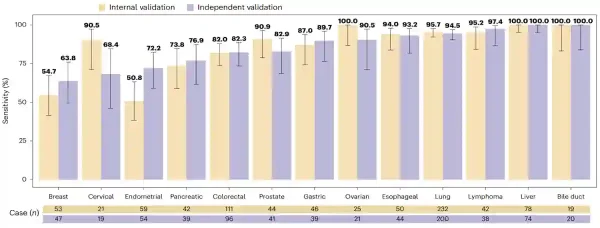
Figure 4. Performance of the liquid biopsy test in multi-cancer early detection. Each pair of bars represents results from two groups: one used to develop the test (internal validation) and another separate group used to confirm the results (independent validation). Overall, the test detected many cancers with high accuracy, often above 80–90% and even reaching 100% sensitivity for some cancers. It works very well for cancers such as lung, liver and ovarian, but is less sensitive for others like breast and endometrial cancer. Overall, the test can identify a wide range of cancers with generally strong performance, though accuracy varies by cancer type. Source: Bao et al. (2025), Nature Medicine.
Then, in 2026, scientists at the University of California, Los Angeles, advanced the field with a new test called MethylScan, designed to detect multiple diseases from a single blood sample. While it also analyses circulating DNA, its key innovation lies in filtering the background signal from healthy cells. In fact, most circulating DNA comes from normal cells, while disease signals, especially in early stages, can make up less than 0.1% of the total. By removing this dominant background, MethylScan amplifies the faint signals coming from tumours or damaged organs.
When tested in over 1,000 individuals, MethylScan showed strong performance across several applications. For high-need cancers where early detection is poor or inconsistent (i.e., liver, lung, ovarian and stomach), MethylScan achieved a sensitivity of 63.3% at a high specificity of 98.0%. MethylScan could also classify liver diseases and detect subtle organ damage by tracing the tissue origins of DNA fragments. In practice, MethylScan shows that liquid biopsy can monitor multiple diseases at once, providing a more holistic view of health.
Multi-cancer and Multi-disease Early Detection
While liquid biopsy has not solved every problem in oncology, it has already shown us something important: a simple blood sample contains far more useful information than we thought. Cancer leaves molecular traces behind, which can reveal how a tumour is evolving, when therapy resistance is emerging, who is at risk of cancer recurrence, and even whether silent cancers or other diseases are developing elsewhere in the body. Initially seen as a safer alternative to invasive tissue biopsies, liquid biopsy has become a tool that could make cancer care more proactive, helping physicians anticipate the disease’s next move before it becomes more dangerous.